
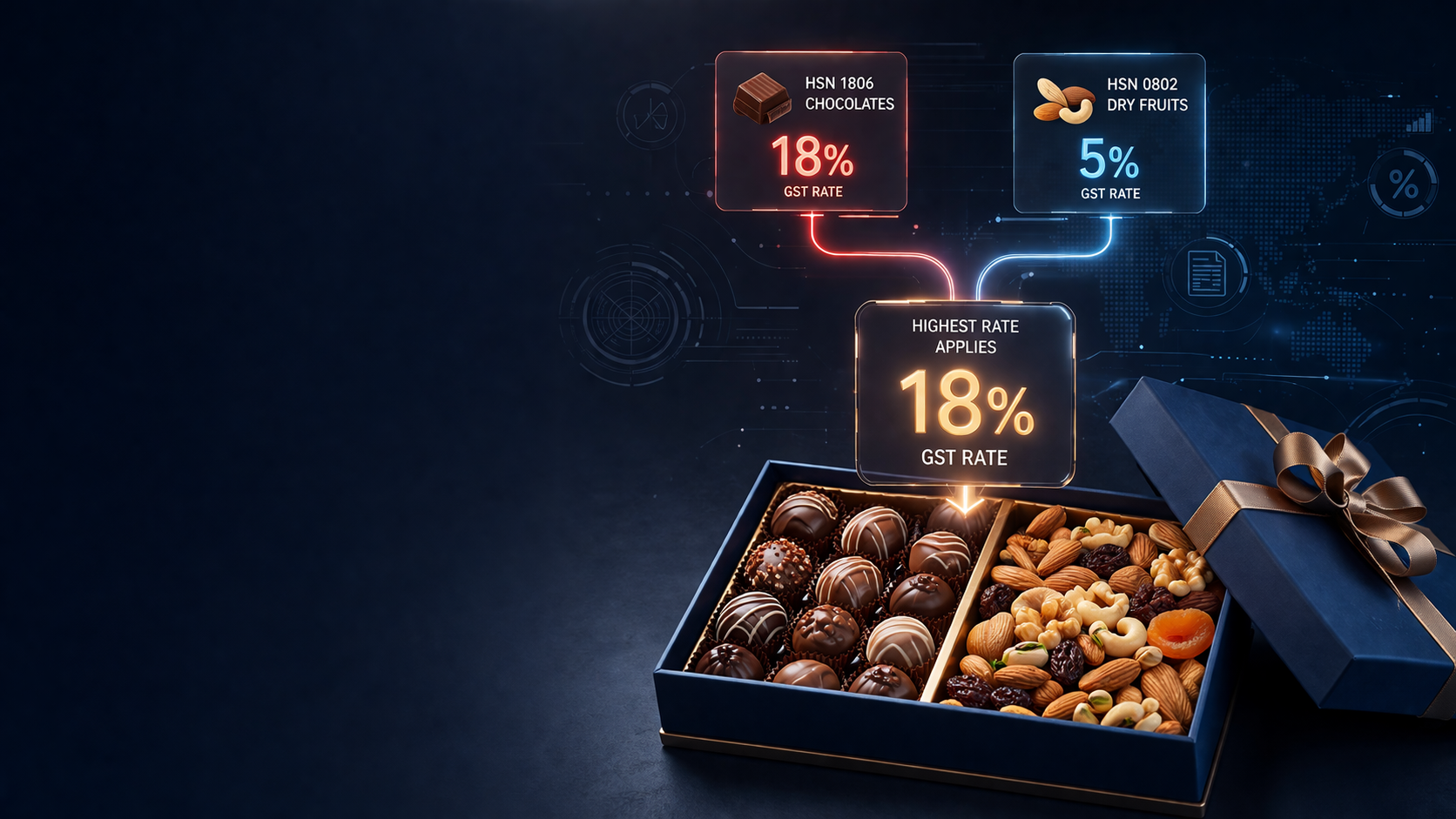
The Setup
A retailer assembles a custom gift box containing chocolates and dry fruits, sold at a single combined price. Two completely different products. Two completely different HSN codes. Two completely different tax rates.
Product 1
Chocolates
HSN Code: 1806
GST @ 18%Product 2
Dry Fruits
HSN Code: 0802
GST @ 5%The Question
What HSN code do you report on the invoice and in GST returns?
At first glance, this looks like a reporting headache with no clean answer. Should you split the invoice? Report both HSN codes? Use a weighted average rate? Apply 5% since dry fruits dominate by weight? Apply 18% because chocolates are the "main" product?
The answer is actually very precise — and it comes directly from the statute. But to get there, you first need to understand a foundational GST concept that trips up even experienced practitioners: the difference between a composite supply and a mixed supply, and which one your gift box actually is.
The Two Categories: Composite Supply vs. Mixed Supply
Section 8 of the CGST Act, 2017 is the provision that governs how GST applies to transactions involving two or more goods or services sold together. It recognises two distinct categories, and the distinction between them determines everything — the applicable rate, the HSN code to report, and ultimately how much tax the buyer pays.
Why the Gift Box Is a Mixed Supply — Not Composite
This is where most practitioners need to pause and apply the test carefully, because the instinct is often to reach for "composite supply" when any two things are sold together. That instinct is wrong here, and understanding why matters.
For a supply to qualify as composite, one element must be naturally bundled with the other in the ordinary course of business. The question to ask is: Would a customer ordinarily buy these two things together as part of a single experience or use-case? Is one inherently dependent on or subservient to the other?
The Natural Bundling Test — Applied to the Gift Box
Are chocolates and dry fruits naturally consumed together? No. They are distinct food products with different use-cases.
Is one product incidental to or subservient to the other? No. Neither chocolates nor dry fruits are an accessory or support item for the other.
Could each item be sold independently? Yes. A retailer routinely sells chocolates alone and dry fruits alone. There is no interdependency.
Are they sold together for a single bundled price as a convenience or gifting solution? Yes. This is the only reason they're packaged together.
Verdict: The gift box is a Mixed Supply under Section 8(b) of the CGST Act.
Section 8(b): The Statute That Settles It
Once the supply is classified as mixed, the statute takes over completely. Section 8(b) of the CGST Act, 2017 states:
"A mixed supply comprising two or more supplies shall be treated as a supply of that particular supply which attracts the highest rate of tax."
— Section 8(b), Central Goods and Services Tax Act, 2017
The rule is absolute and admits no exceptions once the "mixed supply" classification is established. There is no apportionment, no weighted average, no dominant-element test. The law asks one question only: which component in the bundle carries the highest GST rate? That component's rate applies to the entire transaction value.
Applying Section 8(b): Step by Step
The Practical Implication: Why This Matters More Than It Seems
The instinct many businesses have when assembling a mixed bundle is to try to "save" on GST by averaging the rates or splitting the invoice — reporting a portion under HSN 1806 at 18% and the rest under HSN 0802 at 5%. This is a compliance error with real consequences.
Attempting to split the invoice for a mixed supply is incorrect. The entire bundle is a single composite transaction under GST law. Splitting it artificially creates a mismatch in your GSTR-1, invites scrutiny under Section 73/74 (short payment of tax), and potentially leads to a demand with interest and penalty. The law has drawn a bright line — follow it.
The mixed supply rule also has a compounding effect that businesses must account for in pricing. If a retailer assembles a gift box with ₹500 worth of chocolates and ₹500 worth of dry fruits and sells it for ₹1,200:
- → Under mixed supply rules, GST = ₹1,200 × 18% = ₹216
- → What the retailer may have assumed: (₹500 × 18%) + (₹500 × 5%) = ₹90 + ₹25 = ₹115 + margin = ₹1,200 pricing
- → The gap of ₹101 in expected vs. actual GST can directly eat into margins if the pricing was set without accounting for the mixed supply rule
This means businesses assembling mixed gift boxes must price upward to account for the 18% rate on the entire bundle — not a blended rate — or they risk absorbing a higher-than-expected GST outflow from their own margin.
Other Common Mixed Supply Situations in Practice
The chocolates-and-dry-fruits gift box is just one of many real-world situations where the mixed supply rule quietly applies. Here are other common scenarios that practitioners encounter:
| Bundle | Components & Their Rates | Governing Rate |
|---|---|---|
| Diwali hamper | Sweets (5%), Dry fruits (5%), Namkeen (12%), Candles (12%) | 12% |
| Gift set: pen + diary | Ball pen (12%), Paper diary (12%) | 12% |
| Health kit | Honey (Nil), Herbal tea (5%), Protein supplement (18%) | 18% |
| Kids' school kit | Notebooks (Nil), Pencils (12%), Geometry box (12%), Ruler (12%) | 12% |
Notice the health kit example: just because one component (honey) is nil-rated and another (herbal tea) is only 5%, the presence of an 18% component (protein supplement) pulls the entire bundle to 18%. The highest rate governs without exception — even if that component is not the most expensive or the most prominent item in the box.
What If One Component Is Exempt?
This is a nuance worth addressing specifically. If a mixed bundle contains one or more exempt goods — goods that attract zero GST, not just nil-rated, but genuinely exempt — the rule still applies in the same way. The exempt item's rate is 0%, and if another item in the bundle carries 12% or 18%, that higher rate governs the entire bundle.
In other words, mixing an exempt item with a taxable item does not make the taxable item exempt. It does precisely the opposite — the taxable rate colonises the entire transaction. This is perhaps the most counterintuitive consequence of Section 8(b), and one of the most common sources of errors in GST practice.
Practical watch-out: A seller who bundles an exempt item (e.g., unprocessed grains) with a taxable item (e.g., a premium spice mix at 5%) and sells them at a single price cannot claim the bundle is partially or wholly exempt. The 5% rate applies to the entire bundle value under Section 8(b).
The Composite vs. Mixed Test in Practice: A Quick Decision Tree
When you encounter a bundled supply scenario in practice, here is a simple mental framework to determine how to treat it:
Are the goods/services naturally bundled in the ordinary course of business?
Is one element essential to the other? Does the customer expect them together as a single offering?
If YES → Likely Composite Supply. Identify the principal supply and apply its rate.
If NO → Move to Q2.
Could each item be sold separately without affecting the other?
Do both products stand independently on their own as saleable items?
If YES → This is a Mixed Supply. Apply the rate of the highest-taxed component to the full value.
Are they sold at a single consolidated price?
Separate pricing on the same invoice generally allows separate treatment. Mixed supply requires a single price for the bundle.
If priced separately → Each item can be treated independently at its own HSN and rate.
That last point — Q3 — is critical and often overlooked. The mixed supply problem is triggered by the single-price structure. If a seller chooses to separately price each item on the same invoice (e.g., "Chocolates — ₹600 + 18% GST; Dry Fruits — ₹400 + 5% GST"), they may be able to avoid the mixed supply trap altogether. Each line item is then an independent supply with its own HSN and rate. This is not always commercially practical, but it is a legitimate option where pricing transparency allows it.
The Complete Picture — Mixed Supply in Four Lines
A gift box with chocolates (18%) and dry fruits (5%) sold at one price = Mixed Supply under Section 8(b).
The entire transaction is taxed at the highest component rate — 18% — on the full invoice value.
HSN 1806 (Chocolates — highest rate) is adopted on the invoice and in GST returns. No splitting. No blending.
To avoid the trap: price each item separately on the invoice, or factor the 18% rate into your bundle pricing from the start.
What's your take on this? Have you encountered mixed supply situations in your practice or business? Share your thoughts in the comments below.